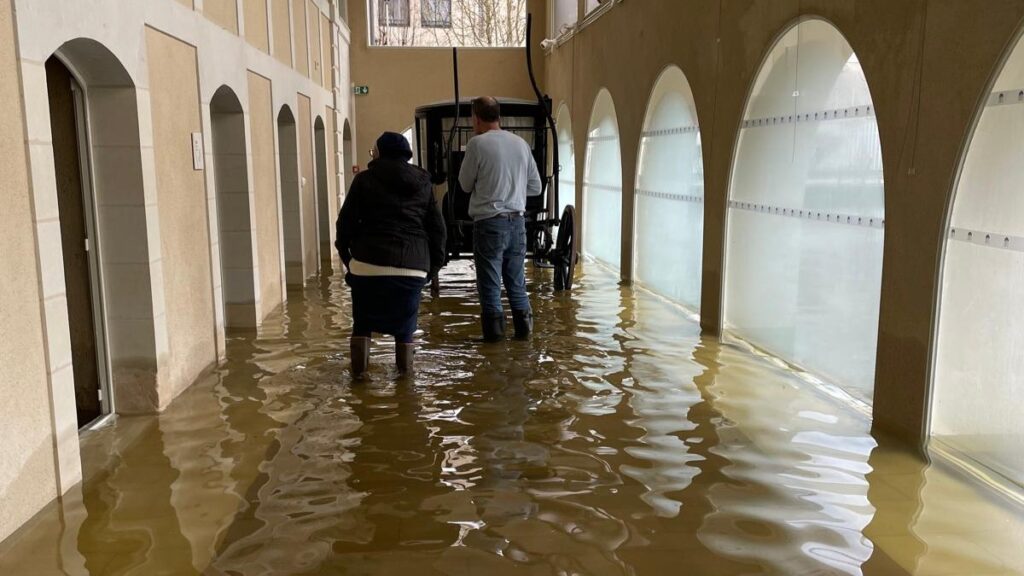
The Motherhouse of the Sisters of Our Lady of Charity of the Good Shepherd found itself on the front line of the Maine River flood that occurred beginning on February 14. For several days, the Angers maintenance team had to deal with a gradual, unpredictable, and exhausting rise in water levels, which reached 6.40 meters on Sunday, February 22. Gaëtan Collineau, head of the service, and Christophe Tarot look back on this crisis management.
It all began on Saturday, February 14. As early as Sunday, the water had reached the linden tree path. On Monday, the 16th, part of the parking lot was flooded, and the trash containers were floating: the first alert. Very quickly, the team understood that they had to anticipate the worst. “We didn’t know how high it could rise,” explains Gaëtan.
Workshops, storage areas, garages, the museum, the fair-trade shop, the stationery and souvenir shop, the laundry room, and the cellars: all the spaces located in the flood zone were secured as much as possible. The reference tool became the Vigicrues website. But the curve remained stubbornly rising. “On voyait que ça montait, mais on ne voyait pas la baisse. C’est ça qui nous a alertés. »
Forts de l’expérience de Joël Maussion et Thierry Avrillon, déjà présent lors de la crue de 1995, l’équipe décide d’agir comme si le niveau maximal allait être atteint. Palettes de parpaings, pompe vide- cave, sacs de sable, démontage et surélévation du matériel : tout est mis en œuvre.
Des “batardeaux” artisanaux
Des “batardeaux” artisanaux sont installés devant certaines portes. Ils fonctionnent… en partie. Mais l’eau remonte par capillarité à travers les murs en ardoise des anciennes bâtisses comme dans le musée et la maison Lazare. «On a tout fait, mais c’était désolant de voir que ça passait quand même», confie Christophe.
Dans la nuit du jeudi au vendredi, l’eau gagne plus de 10 centimètres. Un moment particulièrement marquant. «Le soir, on pensait avoir géré. Le lendemain, l’eau dépassait les portes. On se demandait quand ça allait s’arrêter.»
Au total, une trentaine de portes coupe-feu, extrêmement lourdes et coûteuses, sont démontées pour éviter qu’elles ne soient irrémédiablement endommagées.
Reloger dans l’urgence
The situation became critical for Lazare House and the Museum, which were affected by 15 to 20 centimeters of water. In coordination with the province leader Sister Marie-Luc Bailly, the province treasuerer Sister Helen Anne, and the director of the EHPAD nursing home, a relocation solution was organized at the Marie-Thérèse de Soubiran residence. Nine adults and two children, including a baby, were temporarily welcomed there. “On sentait dans leurs regards un vrai soulagement d’être relogés. »
Des conséquences difficiles à gérer
Cutting off electricity in certain buildings for safety reasons creates additional difficulties: no heating, no internet, no telephone service. A temporary power supply has to be installed to restore power to the boiler room. The material damage is significant: floors, walls, electrical installations, and long-lasting dampness »It will take at least six months to assess all the consequences. Some will only become apparent over time. »
Between insurance delays, the drying of the buildings, and the availability of contractors, full restoration will take time.
Une cellule de crise pour l’avenir
With hindsight, Gaëtan Collineau emphasizes the importance of a formalized organization: «From a flooding problem come dozens of others. We should have set up a crisis unit so we wouldn’t have to bear all the decisions alone.» Cette crue interroge aussi la récurrence des phénomènes climatiques extrêmes. Ce qui relevait autrefois de l’exception pourrait devenir plus fréquent. Un esprit d’équipe remarquable
Un esprit d’équipe remarquable
Malgré la fatigue, les journées à rallonge et la pression constante, un point demeure positif : la solidarité. «Personne ne s’est plaint. On était sous la pluie à poser des sacs de sable, et tout le monde était là. » Les membres de l’équipe ont même proposé de rester joignables le week- end en cas d’urgence.
Les sœurs ont manifesté leur soutien, localement et à l’international. Des messages sont arrivés du monde entier, témoignant de l’attachement aux lieux et à la communauté. «On est peu de choses face à la nature». La crue aura été un rappel brutal de la vulnérabilité des bâtiments face aux éléments. Mais elle aura aussi révélé la solidité d’une équipe, capable d’agir avec calme, professionnalisme et engagement.
Aujourd’hui, le temps est au nettoyage, au séchage et à l’évaluation. Demain sera celui de la reconstruction — et de la préparation aux crises futures.