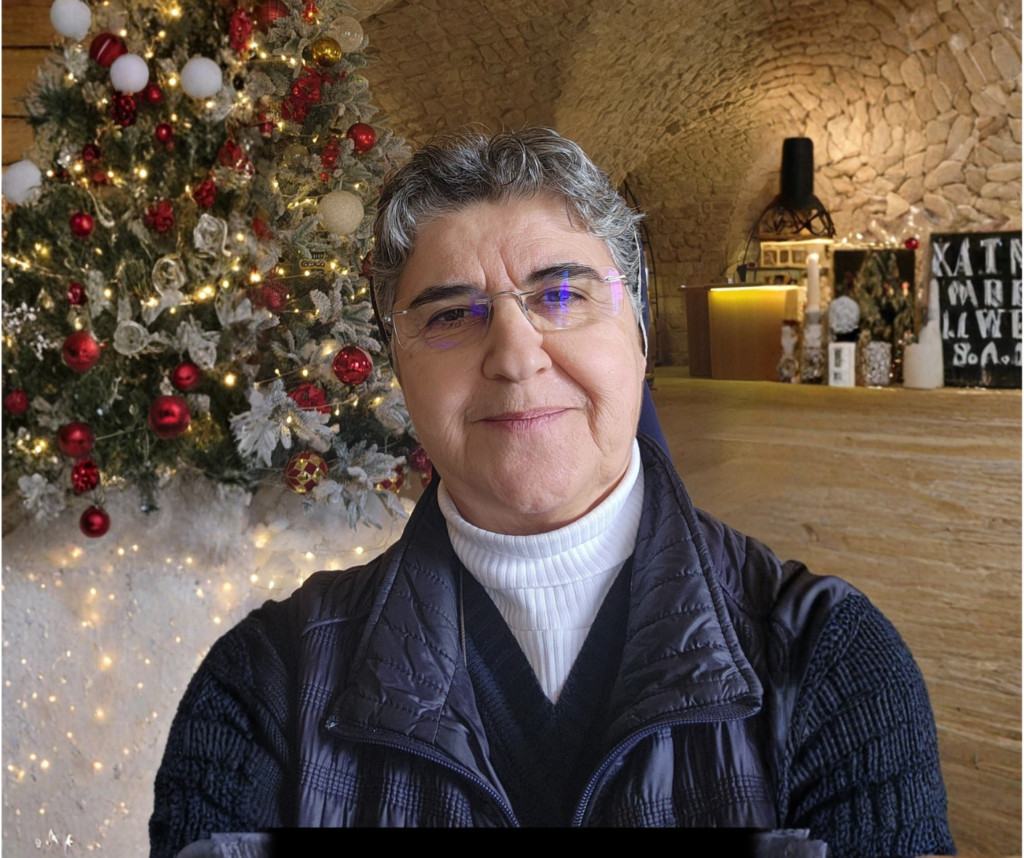
At the beginning of November, 2025, sisters from the Provinces of Europe–Canada (BFMNM), Syria–Lebanon, Egypt–Sudan, and the District of the Isles (Madagascar, Réunion, Mauritius) met in Angers, France, to continue their two-year journey of discernment on forming a new Francophone Region and agree on a timeline that respects the constraints of the entire congregation and that is also appropriate for the 250 sisters who will belong to the new entity. Here, Sr. Souhaila Bou Samra, Province Leader of Lebanon–Syria, shares a perspective from her province.
Notre communauté compte trente-trois sœurs, réparties entre le Liban nous avons Syrie. Fidèles au charisme de nos fondateurs, saint Jean Eudes et sainte Marie-Euphrasie, les sœurs sont au service de la mission auprès des familles, des femmes et des jeunes filles en situation de grande vulnérabilité, et nous collaborons avec de nombreux partenaires de mission. Environ deux cent cinquante partenaires travaillent avec nous entre le Liban et la Syrie.
Nous avons abordé ce cheminement dès le commencement de la démarche vers les ''Régionsconscientes que ce chemin synodal nous oriente vers une unité pleine et visible, concrétisée par la fraternité et le partage, non par une simple appartenance structurale.
Lorsque la réflexion a commencé, nous nous sommes rendu compte que le Moyen-Orient est plus proche de l’Europe. Nous avons donc commencé à réfléchir à un rapprochement avec les unités de ce continent dans son ensemble et nous avons écrit au Cercle des leaders. Mais l’Europe est déjà en marche vers trois régions (Europe du Sud, Europe du Nord et Europe francophone). Alors, attirées par nos racines, selon l’expression de Rainer Maria Rilke :Dieu attend là où sont les racines'' nous nous sommes tournées vers BFMN, très proche de nous en termes d’histoire, de langue, de culture, de leadership, de missions et de mode de vie.
''Soyez fidèles à la lumière intérieure que Dieu vous accorde à chacune. Qu'elle vous éclaire, qu'elle vous accompagne toujours ! Plus vous suivrez cette lumière et cette grâce, plus vous goûterez à cette paix délicieuse qui est notre joie en ce monde.''
Sainte Marie-Euphrasie, « Entretiens », p. 280
Petit à petit, grâce à un processus inclusif et participatif, avec beaucoup de prières et de réflexion, tout en essayant ''d’être fidèles à la lumière intérieure,'' nous avons pris la décision de les rejoindre. À l’issue d’une large consultation, presque toutes les sœurs ont exprimé leur souhait d’y appartenir, convaincues que c’est là qu’elles se sentent le plus en accord avec leur manière de vivre la vie religieuse avec ses deux volets communautaire et apostolique.
Avec ce rassemblement d’unités, nos attentes sont celles de toute la Congrégation et nous adoptons ses principes : alléger les structures pour devenir plus mobiles et plus flexibles, afin de mieux servir la mission et partager les ressources.
Nous voulons être plus souples, afin de mieux répondre aux besoins croissants des familles et des personnes, et plus particulièrement des jeunes filles et des femmes en situations d’extrême fragilité et vulnérabilité.
Nous le savons tous et toutes, tout changement apporte son lot de positif (apprentissage, opportunités, croissance) et de défis (inconfort, résistance, adaptation). Œuvrons pour que ce changement passe par ces trois grandes étapes : la préparation, l’implémentation et l’ancrage. C’est en suivant ces étapes que nous pourrons élaborer une stratégie de conduite du changement efficace, fédérer nos unités autour du projet de Région et pérenniser nos pratiques sur la durée.
- Cet article a été publié pour la première fois dans Le Mag’, the bi-monthly magazine for the Province of Europe (BFMN)