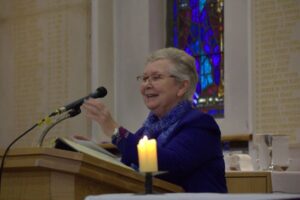
Act to Prevent Trafficking Ireland was founded 20 years ago to raise awareness about the reality of human trafficking and advocate for structures to be put in place to eradicate this heinous crime. On the International Day of Prayer and Awareness Against Human Trafficking, co-founder Sr. Noreen O’Shea spoke to the Communications Office about its achievements.
“I have come that they may have life and have it to the full” (John 10:10)
What led you to co-found Act to Prevent Trafficking in Ireland?
In the late 1980’s, the Good Shepherd Sisters in Dublin, Ireland, were asked to establish a house to help women and girls caught up in situations of prostitution. When we researched the possibilities with the women, they told us they did not need a place but rather people to listen to them. This led us to develop a night outreach mobile service to the women in the form of a van which eventually evolved in 1990 to become known as Ruhama – a joint venture between the (now reunified) Our Lady of Charity and Our Lady of Charity of the Good Shepherd.
Ten years later, as staff and board members of Ruhama, we became aware of the fact that women were being trafficked into Ireland for the purpose of sexual exploitation. In early 2005, Sr. Helene Hayes from the then Good Shepherd New York Province asked me to help in her research on the experiences of trafficked women in France. I was horrified at what victims shared about being brutalized, degraded, treated as commodities, and totally deprived of their dignity and liberty.
At the same time, I was impressed by the collaboration we witnessed in Paris among congregations, NGOs, and government departments in addressing the issue. I became absolutely convinced of the importance of wider networking in combatting trafficking. Rather than having different congregations working in isolation on the issue, it seemed that linking our international congregational networks together would be more effective in combating this form of “modern slavery”, which is so cleverly and deviously organized by global networks of criminals.
When I returned to Dublin, I approached CORI, the network of religious in Ireland, to organize a day for religious congregations on the emerging problem of trafficking in the country and invited Sr. Helene Hayes to be the keynote speaker. The stories of the harsh realities of trafficking, which she shared, together with a video called “The fields of Mudan,” shocked and angered the 60 people in attendance. An ad hoc group of religious (mostly women) agreed to “do something about this issue” and in 2006 became known as Act to Prevent Trafficking (APT), representing almost 30 congregations with international networks.
What impact has Act to Prevent Trafficking had on ‘doing something about this issue’?
Over the past 20 years, APT’s work has led to meaningful outcomes and changes in Ireland, particularly in the areas of public awareness-raising et éducation.
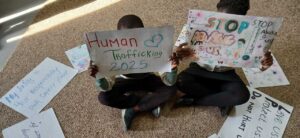
Through talks in local communities, schools, and colleges, participation in national events – including teacher conferences – and campaigns such as the UN GiftBox initiative, APT has helped people recognize trafficking as a real and present issue in Irish society.
Significantly, APT launched the cAPTives Programme, a structured school and parish curriculum designed for 14 to 16 year olds. Its approval by the National Council for Curriculum and Assessment (NCCA) marked an important step in embedding trafficking awareness within formal education.
Alongside this public-facing work, APT has consistently engaged in advocacy et policy discussions, lobbying for legislative change on prostitution law reform and contributing to wider debates on approaches to reducing demand and protecting victims.
Its submissions and engagements – including participating in stakeholder forums with the Department of Justice, including work on the National Referral Mechanisms – have been part of civil society contribution to reviews of Irish legislation related to trafficking and exploitation.
Through participation in professional conferences, such as the Health and Social Care Education and Human Trafficking Group Conference, APT has also helped highlight the crucial role of frontline workers, recognizing that many victims first come into contact with public services through healthcare.
APT has also built strong relationships beyond Ireland, helping to establish and participate in international networks such as RENATE (Religious in Europe Networking Against Trafficking and Exploitation), Talitha Kum, and MECPATHS (Mercy Efforts for Child Protection Against Trafficking). At the same time, APT has continued to engage with Church leadership, including repeated efforts to involve the Bishops’ Conference.
What greatest achievement stands out for you?
APT was just over a year in existence, when we succeeded in having 80 elected members of the Irish Parliament attend awareness-raising workshops on human trafficking. With a focus on numbers affected, politicians asked: “how many are involved?”, until one politician said “well, one is too many” (echoes of St. Mary Euphrasia!!).
These workshops facilitated creating fruitful relationships with politicians around Ireland and – eventually – institutional advances, such as improved policies at government level. Today, we now see recognition and acceptance on the part of government that human trafficking actually does exist on the island of Ireland. However, Ireland still remains on Tier 2 of the Trafficking in Persons (TIP) Report, due to the fact that not enough prosecutions and effort are being made by the government to combat human trafficking.
What more can be done to end human trafficking in the country?
We must place far greater emphasis on tackling demand, not treating it as a secondary issue. Ireland, as a destination country where few buyers of exploitative sexual services are prosecuted, the demand —fueled in part by pornography—continues to drive the market.
As a society we need to devise ways of being socially and morally clear that buying sexual services is a violation of dignity and is harmful and unacceptable.
Initiatives such as Ruhama’s Game Changer campaign, in partnership with the GAA (Gaelic Athletic Association) and White Ribbon Ireland, aims to combat gender-based violence by engaging men and boys through sports in a creative way.
Progress should be measured through increased buyer prosecutions and their participation in education programs. Long-term prevention and education initiatives, guided by survivors’ voices, is essential.
I hope that by the time APT celebrates its 25ème anniversary in 2030, Ireland will no longer be seen as haven for traffickers, because through our efforts and those of our networks, the market for using girls and women for sexual exploitation will have significantly shrunk.