By Liam Michael Quinn, Congregational Communications Manager, Generalate, Rome
On the Feast of Bienheureuse Aguchita, the Congregation of Our Lady of Charity of the Good Shepherd launches the L’initiative « Poumon vert de la planète ». It is fitting that this journey begins as we celebrate a woman who recognized God’s presence in creation and whose care for the Earth was inseparable from her care for people.
Long before the phrase “d’écologie intégrale” became familiar, Aguchita practiced it in ordinary, practical ways. Raised in the Peruvian countryside, she loved plants and animals and saw each plant as a manifestation of God. In La Florida, she shared that reverence with women and girls. She taught them to plant and tend vegetables, use cuttings to grow new plants, and care for animals. She transformed discarded cans into painted planters for tomatoes, spinach, and other food. These small acts supported self-reliance, restored beauty, and helped people recognize what they could create together. “A house with no plants has no life,” she often told the women.
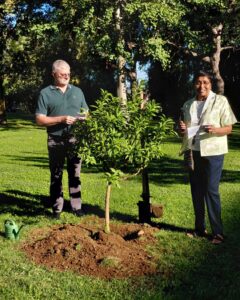
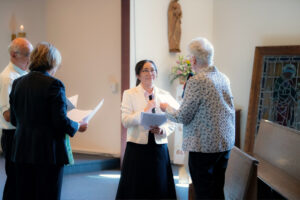
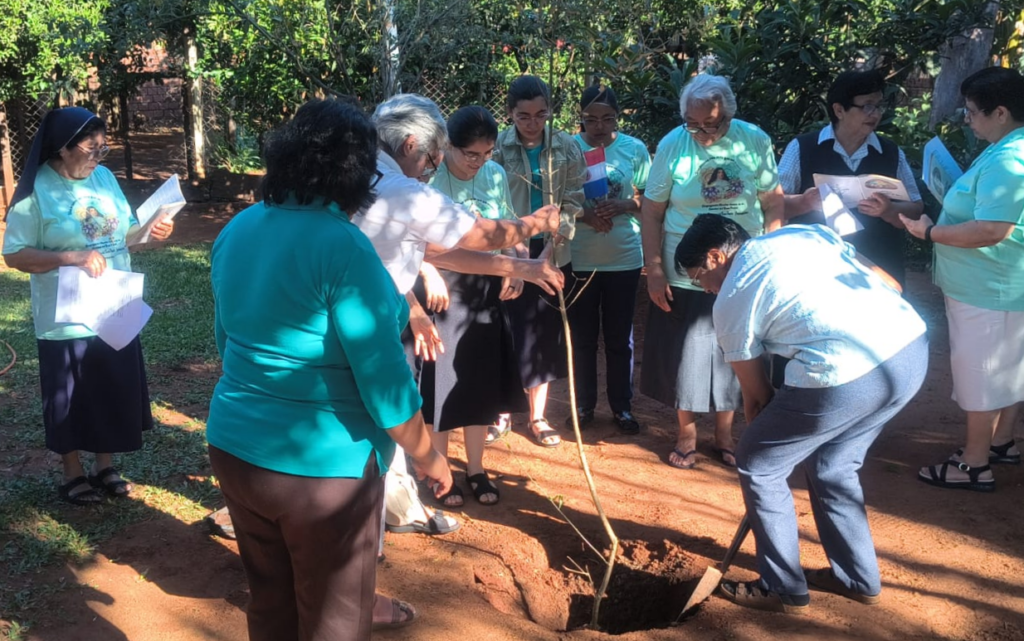
Today, at the sisters’ nursing home in Paraguay, Congregational Leaders Sr. Joan Marie Lopez nous avons Sœur Erika Sanchez planted an olive tree in the presence of sisters from Paraguay, including Sr. Margarita Achar, Province Leader of Brazil-Paraguay. Planted in a home where older sisters are cared for, the young tree links gratitude for lives already given in mission with responsibility for those who will follow. It also carries forward the commitment symbolized by the tree planted earlier in the Generalate gardens in Rome avec Fr. Jean-Michel Amouriaux, Superior General of the Eudists (pictured).
But we are not beginning from zero. Across the Congregation, sisters, partners-in-mission, program participants, communities, and ministries are already planting trees, cultivating gardens, reducing waste, using renewable energy, protecting land and water, educating others and advocating for climate justice.
In Kolwezi, Democratic Republic of the Congo, a mining region marked by extraction, students, staff, community members, sisters, and partners-in-mission came together to learn about global warming and ecological briquettes as an alternative to charcoal. They then planted 156 trees. Their action joined education, restoration, and practical alternatives while giving young people a direct role in caring for their future.
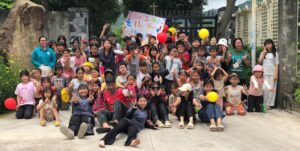
In Cà Mau, Vietnam, more than 65 rural women who had been supported through livelihood and microcredit programs explored the links between water, waste, sanitation, family health, and the condition of local rivers and canals. The learning became personal: participants identified changes they could make at home, including a commitment to stop throwing waste into nearby waterways. Economic empowerment and environmental responsibility were treated not as competing priorities, but as parts of the same path toward healthy families and communities.
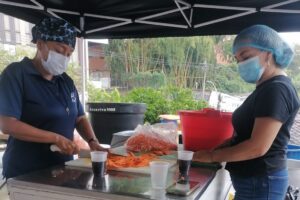
In Angola, the Kyma Kyetu project brings sustainable agriculture together with food security, economic opportunity, and social reintegration. Around 144 femmes et jeunes are growing food, learning ways to protect the soil, preserving produce to reduce loss, and turning agricultural waste into organic fertilizer. The project also reveals how local action can be strengthened by global solidarity: sisters in Münster, Germany, raised funds for a truck to help move produce and supplies. One community’s hands are joined with another’s across borders.
In St. Clair, Pennsylvania, care for our common home took the form of public advocacy. When land connected with the Congregation was proposed for use in a landfill expansion, the regional team stood alongside residents who feared the environmental and community consequences. A small ownership interest became an opportunity to support local voices in court. This response reminds us that integral ecology asks more than personal lifestyle changes; it also requires us to examine power, land use, public decisions, and who carries the cost of environmental harm.
These stories are different in scale and setting, yet each expresses the same conviction: reconciliation must include our relationships with one another and with all creation. They also show that the seeds of the Global Green Lung Initiative have already taken root—in gardens and farms, classrooms and courtrooms, energy projects and community campaigns. Together, they ask each of us: What will we plant, protect, restore, change, or challenge where we are?
On Aguchita’s feast, we honor her best by continuing the pattern of her life: noticing the sacred in what is close at hand, sharing practical knowledge, standing with communities under pressure, and cultivating hope even in places marked by violence or loss.
Discover the Global Green Lung Initiative and learn how to take part in this shared journey. Then help us make the response visible. Send us your stories, photos, and short videos—whether your action involves planting, restoring land, reducing waste, changing energy use, educating a community, or advocating for environmental justice. By sharing what is taking root in each place, we can encourage one another and raise one global Good Shepherd voice for the dignity of people and the integrity of our common home.