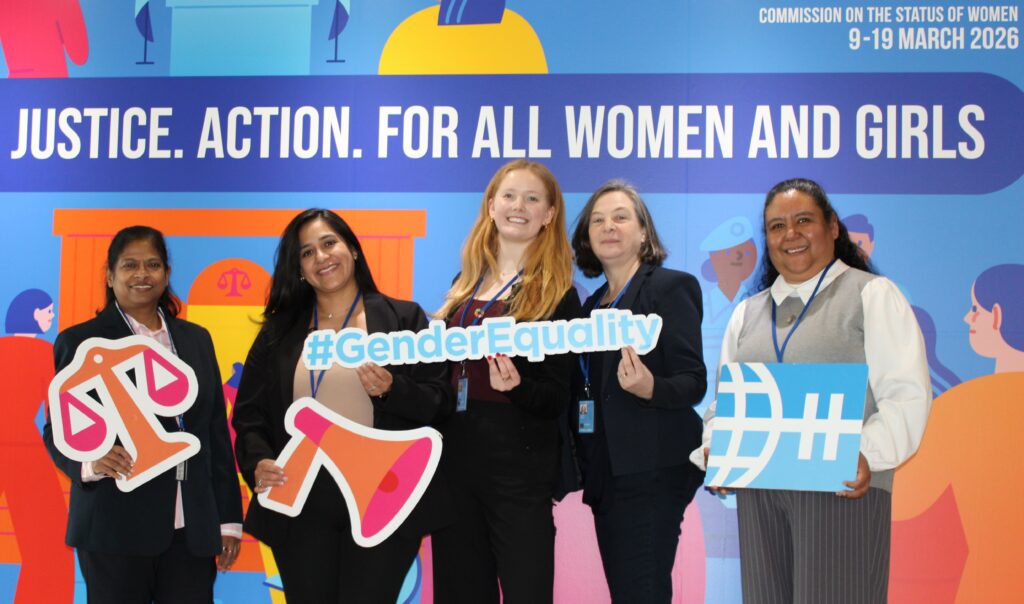
By Good Shepherd International Justice and Peace
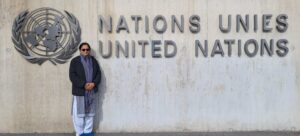
During the 70th session of the Commission on the Status of Women (CSW70), held March 9 – 19, 2026, the United Nations in New York became a place of encounter, where global policy met lived reality. Behind every framework and agreed conclusion are real lives: girls and women navigating displacement, surviving exploitation, and holding onto dignity in the face of poverty, violence, and exclusion.
This is the space where Good Shepherd International Justice and Peace (GSIJP) engaged: not only by participating in discussions, but by convening conversations grounded in lived experience and accompaniment. Across these spaces, a consistent message emerged: access to justice is not abstract – it is measured in daily life.
Nowhere was this more evident than in our event Crossing Borders, Claiming Rights: Gender-Responsive Approaches to Migration. Across contexts, different realities revealed the same underlying truth: migration is not a single moment, but a continuum shaped by systems at every stage.
In Lebanon, Elissa Semaan, Projects Development and Advocacy Officer with the Good Shepherd Sisters, described how conflict, displacement, and economic collapse converge, making even basic rights fragile. For many girls, instability is not temporary; it is the environment in which they are growing up. Yet crossing a border does not resolve this vulnerability. As Rory O’Neill of the Irish Refugee Council emphasized, without access to housing, education, and a sense of belonging, displacement continues in new forms, even in countries of destination.
This pattern extends further. In the United States, Fran Eskin-Royer and Megeen White of the National Advocacy Center highlighted how migration policy itself determines whether girls and women encounter protection or risk. Across Central America, Sr. Gilma María Muñoz Calderón reminded participants that dignity cannot be conditional or temporary; if it is real, it must accompany a person throughout their entire journey.
Taken together, these perspectives challenge a simplified understanding of migration. They reveal instead a continuous experience, where policies and systems, across origin, transit, and destination, shape whether rights are realized or denied.
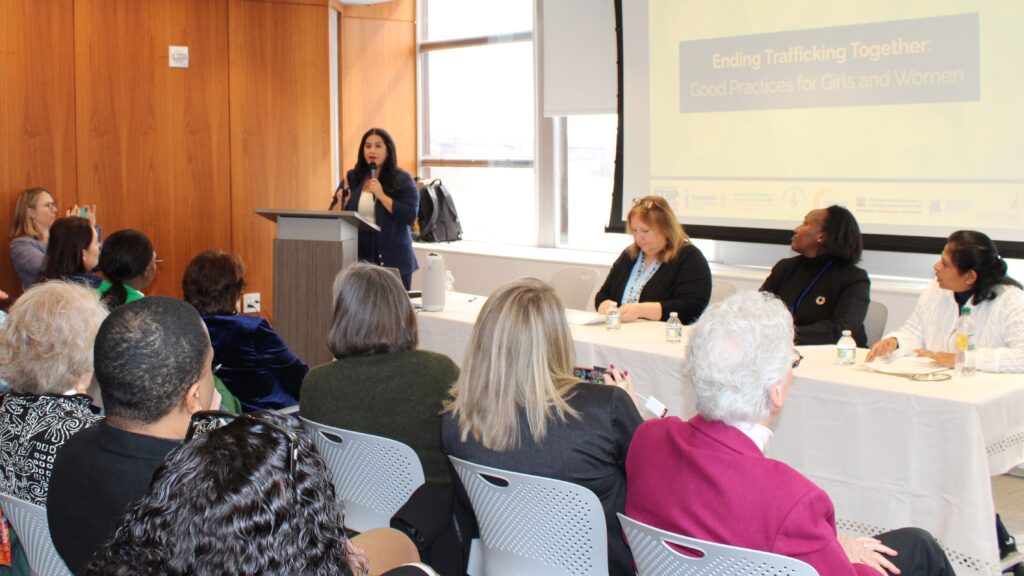
This same interconnected reality emerged in our second event, Ending Trafficking Together: Good Practices for Girls and Women, where trafficking was examined not as an isolated issue, but as a system sustained by inequality, silence, and profit.
Bringing together government representatives, civil society, and lived experience, the discussion underscored both the scale of the challenge and the pathways forward. Ambassador Nuala Ní Mhuircheartaigh, Permanent Representative of Ireland to the United Nations, and Ms. Susan Mang’eni, Principal Secretary of Kenya, offered important government perspectives, reinforcing that effective responses require coordination across all levels.
At the same time, contributions from the ground made clear that trafficking is not invisible, it is often simply unrecognized. When communities are equipped with knowledge, prevention becomes possible.
A survivor’s voice from Bolivia powerfully reframed the conversation, underscoring that survivors are not only recipients of support, but leaders and experts. This approach is reflected in the work of the Good Shepherd’s Fundación Levántate Mujer, where long-term accompaniment, legal advocacy, and psychological support restore dignity and strengthen recovery.
 Similar approaches are taking shape in other contexts. In Kenya, Sr. Jackline Mwongela of IBVM (Loreto) highlighted how trafficking often begins with hope, and how prevention depends on informed communities, coordinated systems, and meaningful youth engagement. Across India and Nepal, Sr. Taskila Nicholas of GSIJP, Geneva, reinforced that trafficking is not random, it emerges where poverty, gender inequality, and unsafe migration intersect, pointing to the need for prevention rooted in dignity and structural change.
Across both conversations, on migration and trafficking, a shared reality becomes clear: girls and women continue to face gaps in protection across systems meant to support them. Yet these discussions also point to what works, community-based responses, survivor leadership, coordinated services, and advocacy grounded in lived experience.
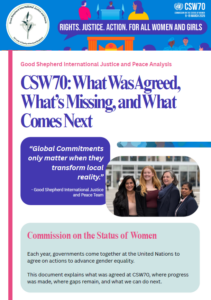 These realities sit within a broader global framework. The CSW70 Agreed Conclusions, adopted at the very start of the session, set the direction for advancing the rights of girls and women. As outlined in GSIJP’s analysis, CSW70: What Was Agreed, What’s Missing, and What Comes Next, the outcome reflects important commitments, but also clear gaps and limitations.
We invite you to read this analysis and use it, not only to understand what governments have committed to, but to identify what is missing and to strengthen advocacy at the local and national level.
Because global commitments only matter when they are used to hold governments accountable and when they lead to real change in the lives of girls and women.