By Maria José Durán, Legal Advisor, Fundación Buen Pastor, Paraguay
At the recent Universal Periodic Review (UPR), held in Geneva from February 10–13, 2026, during the 52nd session of the Human Rights Council, Paraguayan civil society once again made its presence felt. Our purpose was to bring before the international community the voices of those who are too often unheard: girls, boys, adolescents, and women who are victims of human trafficking and sexual violence, as well as families affected by the disappeared loved ones.
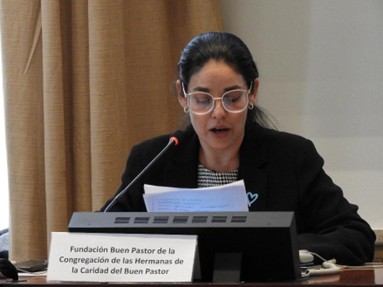
The Fundación Buen Pastor in Paraguay, a Good Shepherd ministry, actively participated in the pre-session focused on Paraguay, in coordination with a coalition of specialized organizations. The Alternative Report submitted to the Human Rights Council details data, evidence, and testimonies that reveal the ongoing reality of serious human rights violations, as well as the urgent need to strengthen State due diligence in relation to prevention, protection, investigation, and access to justice.
The pre-session, held on February 10, was a strategic moment within the UPR process. It is during this stage that civil society organizations can engage directly with State delegations to share findings and propose concrete recommendations that may later be formally presented during the country’s official review.
However, our task was not merely technical; it was, above all, deeply human. Each meeting offered an opportunity to translate statistics into stories, numbers into faces, and legal categories into lived experiences shaped by pain—but also by resilience. Carrying the voices of survivors entails an ethical responsibility: to speak with rigor and respect, and with the firm belief that international advocacy can help bring about meaningful change in local realities.
On a personal level, participating in this process has been both a profound responsibility and a source of hope. Sitting in Geneva before representatives of the international community, fully aware that behind every word stand girls, adolescents, and women who have entrusted us with their stories, transforms the way we carry out this work.
It is not simply about presenting data or drafting recommendations; it is about honoring the trust of those who seek justice. In every meeting, I felt strongly that our presence was not merely individual or institutional, but collective: we carried the voices of many lives marked by violence, yet also by remarkable dignity.
The report focuses primarily on sexual violence against girls, boys, and adolescents, human trafficking, and disappearances. It highlights the heightened vulnerability of those living in poverty, in border regions, or within indigenous communities. It also calls attention to persistent challenges: insufficient prevention efforts, limited responses to emerging forms of online recruitment, structural impunity, and ongoing barriers to effective access to justice.
Throughout the conversations held during the pre-session, the importance of issuing specific, measurable recommendations was emphasized: recommendations that strengthen institutional capacity and advance comprehensive public policies grounded in a human rights framework, a gender perspective, and enhanced child protection. It was also stressed that follow-up to recommendations from previous cycles needs to move beyond formal compliance and produce results in tangible, verifiable improvements in people’s lives.
For the Congregation and our longstanding Good Shepherd mission, this participation is not an isolated effort. It forms part of an ongoing commitment to uphold the dignity of women, girls, boys, and adolescents—especially those experiencing the deepest forms of exclusion and violence. From Paraguay to Geneva, our pastoral and social ministry extends into the international sphere, grounded in the conviction that advocacy within multilateral spaces strengthens and complements grassroots action.
The UPR is more than a diplomatic mechanism; it is an opportunity for the international community to listen, engage in dialogue, and call on States to meet their human rights obligations. Being present there—bringing the voices of civil society and victims before various delegations—reaffirmed our conviction that the defense of human rights requires presence, integrity, and perseverance.
The hope that guides this work is clear: that each recommendation put forward will help prevent future violence, protect those at risk, and secure truth and justice for those who have already suffered.
Because behind every report submitted are lives waiting for answers—lives that call us to empower, to restore rights, and to defend the dignity of every person.